
“The Hell of the North” has always been known for its brutality, but in 1994 complete chaos ruled — even from a technical perspective.
At the mention of Paris-Roubaix, you think of dust, mud, broken wheels, and battered faces fighting for victory on ancient cobblestones. But in 1994, it was not only about human endurance — it became an engineering challenge and a bold experiment.
In the mid-1990s, Paris-Roubaix turned into a testing ground for unconventional ideas. The famous "pavé" sectors, especially Carrefour de l'Arbre and Arenberg, were so unforgiving that riders and engineers were forced to search for better comfort and control. The solution? Suspension.
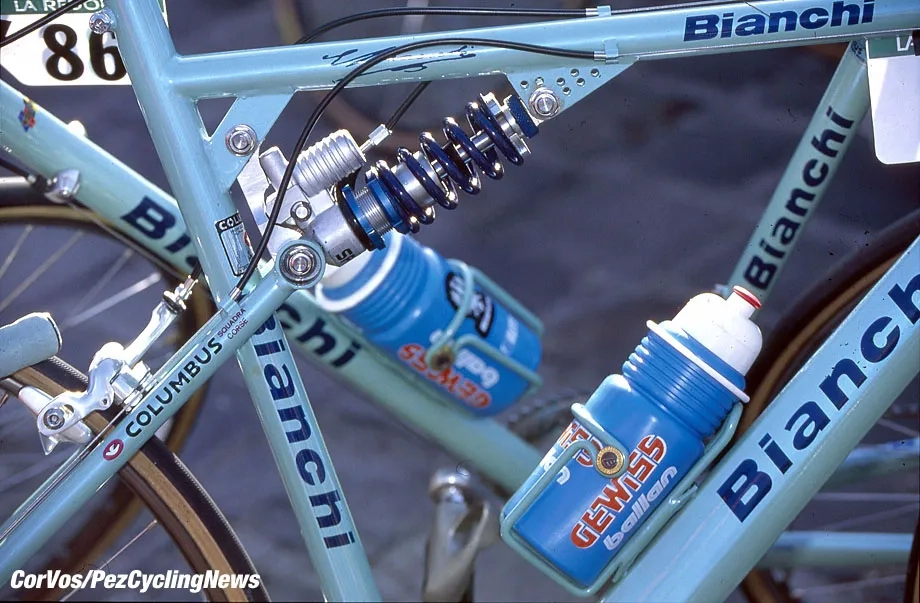
Johan Museeuw’s Full-Suspension Bianchi (Belgium)
Museeuw, one of the stars of the era, rode a fully suspended Bianchi equipped with a rear coil spring. The goal was improved comfort and control over the cobbles. However, the plan failed — the frame cracked during the race and he was unable to finish.
Greg LeMond’s Titanium Bike (USA)
LeMond started on a titanium Clark-Kent frame fitted with a RockShox front suspension fork and a unique rear damper offering 2 inches of travel. Additionally, he had a handlebar-mounted control button that allowed him to adjust suspension while riding. Technologically, it was far ahead of its time.
Gilbert Duclos-Lassalle with RockShox Suspension (France)
Duclos-Lassalle, a two-time champion, used a RockShox front suspension fork. However, in 1994 a puncture ended his chances. Still, he demonstrated that suspension was not just a gimmick — it could help win the race.
Andrei Tchmil – The Winner (Moldova)
While others experimented with radical setups, Tchmil chose a balanced approach: his bike was equipped with only a front RockShox suspension fork. This allowed him to launch a solo attack 67 km before the finish. The strategy worked, and he entered the Roubaix velodrome as the winner.
The year 1994 became one of the boldest periods of technological experimentation. Suspension systems soon disappeared from professional road racing — they proved heavy, complex, and unpredictable. However, the lessons learned that year influenced the comfort of modern road bikes: improved frame compliance and wider tires.
The 1994 edition of Paris-Roubaix was not just a race — it was a battlefield of ideas and one of the most memorable years in cycling history.
Comments (0)
No comments yet.